
Which groups are on your target?
Consider NHS for primary amines and Maleimide for free thiols. For click chemistry, confirm the reaction partners first.
Deep-red fluorescent labeling with 5 reactive dyes and 4 bioconjugates. Match the target handle to a labeling route and evaluate with 633/640 nm red excitation and far-red detection.
Optical values refer to AF647 NHS.
Find AF647 dyes and conjugates by reactive group or recognition ligand.
Consider NHS for primary amines and Maleimide for free thiols. For click chemistry, confirm the reaction partners first.
Compare Annexin V, WGA, CTB, Streptavidin; check the sample and conditions.
| Product / catalog no. | Reactive form / ligand | Targets and applications | Documents |
|---|---|---|---|
| AF647 NHS EsterQH-10-1011 | NHS | Antibodies, proteins and other molecules with accessible primary amines | View product → |
| AF647 MaleimideQH-10-1011(Maleimide) | Maleimide | Targets with accessible free thiols | View product → |
| AF647 AzideQH-10-1011(Azide) | Azide | Targets with a compatible alkyne; confirm the click reaction system | View product → |
| AF647-PEG4-DBCOQH-10-1011(DBCO PEG4) | PEG4-DBCO | Azide coupling with a PEG4 spacer | View product → |
| AF647-PEG12-DBCOQH-10-1011(DBCO PEG12) | PEG12-DBCO | Azide coupling; evaluate a PEG12 spacer | View product → |
| AF647-Annexin VQH-10-1011(Annexin V) | Annexin V | Recognizes exposed PS; binding requires Ca²⁺ | View product → |
| AF647 WGAQH-10-1011(WGA) | WGA | Recognizes glycans containing GlcNAc or sialic acid | View product → |
| AF647 CTBQH-10-1011(CTB) | CTB | Recognizes GM1; consider binding and uptake conditions | View product → |
| AF647-StreptavidinQH-15-1010 | Streptavidin | Detect existing biotin labels using Streptavidin | View product → |
Showing 9 / 9 AF647 products
Values refer to this product’s specifications. Consult measurement records for solvent, pH and conjugation state.
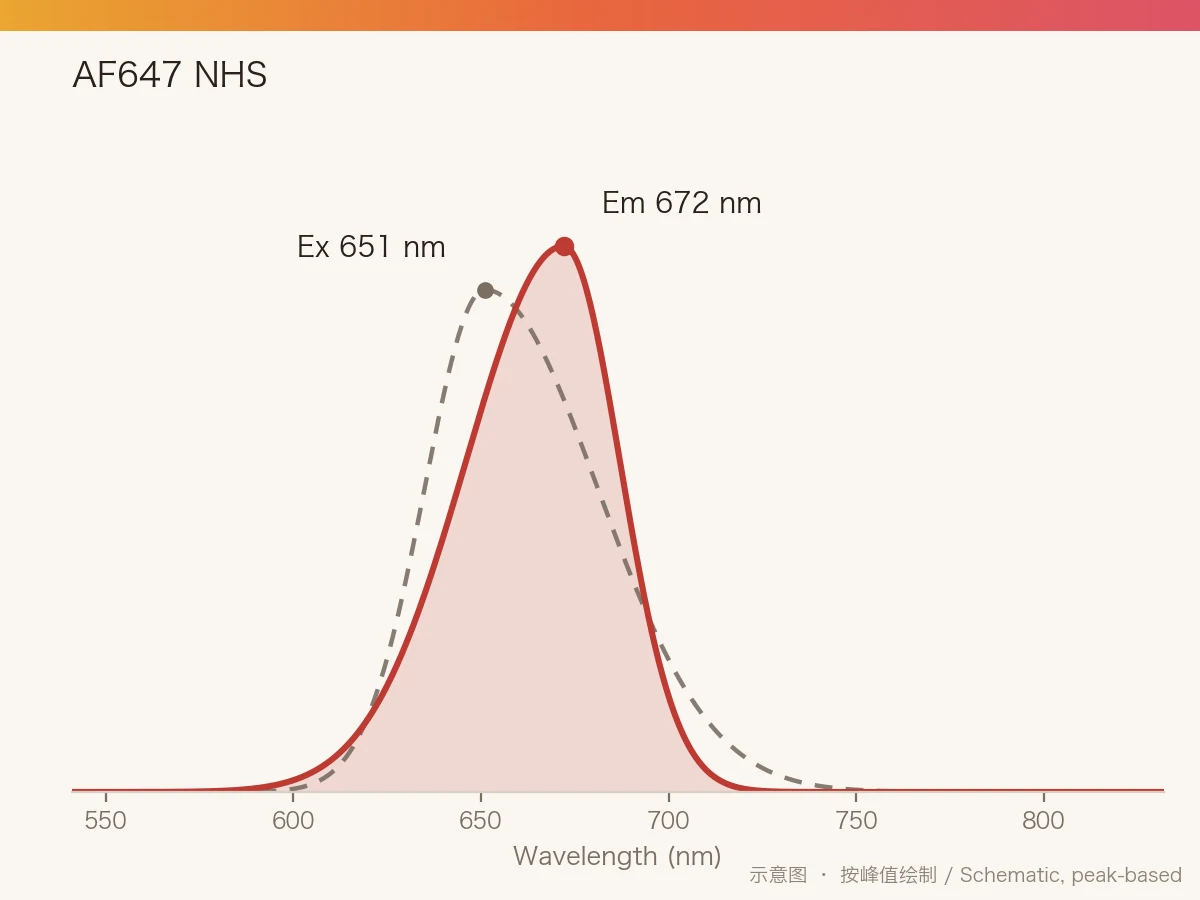
Full product specifications →This product has a 651 nm excitation peak and a 672 nm emission peak. A 633 or 640 nm red source is a starting point for compatibility assessment; confirm signal using absorption, power, sample and optical settings.
A 670/30 bandpass filter nominally covers 655–685 nm, including the 672 nm peak. Check actual filters and detector response; APC or Cy5 channel presets can differ between instruments.
Read the detection guide →AF647, APC and Cy5 can occupy overlapping far-red collection windows. Use dye-matched single-stain controls to assess compensation or spectral unmixing. Do not substitute an APC control for AF647 or infer independent detection from peak differences alone.
Multicolor detection considerations →For established recognition ligands, review the corresponding conjugates and their product-specific formulation, dose and storage conditions.
| Product | Recognition target and conditions |
|---|---|
| AF647-Annexin V | Phosphatidylserine; binding is Ca²⁺ dependent. |
| AF647 WGA | GlcNAc- or sialic-acid-containing glycans; consider sample preparation and intracellular signal. |
| AF647 CTB | GM1 ganglioside; confirm the application and treatment conditions. |
| AF647-Streptavidin | Biotinylated targets; account for competing free biotin. |
References on reaction chemistry, assay design and result interpretation.
Nanda JS, Lorsch JR. · Methods in Enzymology · 536:87–94 · 2014
Uses FAM ester labeling of a protein to explain primary-amine chemistry and labeling-efficiency assessment. It informs NHS workflow design; input and reaction conditions depend on the actual dye and sample.
Vira S, Mekhedov E, Humphrey G, Blank PS. · Analytical Biochemistry · 402(2):146–150 · 2010
Uses FITC-labeled anti-HA antibody to assess changes in labeling density and antigen binding. It informs input-series design and post-purification functional testing; DOL alone is insufficient for selecting a conjugate.
Cossarizza A, Chang HD, Radbruch A, et al. · European Journal of Immunology · 51(12):2708–3145 · 2021
Provides methodological guidance on detection settings, controls and experimental records for downstream conjugate evaluation.
Dempsey GT, Vaughan JC, Chen KH, Bates M, Zhuang X. · Nature Methods · 8(12):1027–1036 · 2011
Compares photoswitching, photon output and localization-image quality, defining useful criteria for super-resolution probes. Excitation and emission peaks alone do not establish STORM performance.
DOI: 10.1038/nmeth.1768
AF647 NHS has 651 nm excitation and 672 nm emission peaks. Signal with a 633 or 640 nm laser depends on absorption at that wavelength, source power and sample concentration. The name does not require a 647 nm laser.
A 670/30 bandpass nominally covers 655–685 nm and includes the 672 nm peak; a 660/20 filter covers 650–670 nm. They collect different portions of the emission. Check measured emission, filter transmission and dichroics rather than choosing by the APC channel name alone.
Keep source, gain, exposure or dwell time fixed for sample comparisons, with unstained and single-stain controls. The peak illustration contains no measured bandwidth; compensation or unmixing requires single-stain references matched to sample treatment.
documents.thermofisher.com
tools.thermofisher.com
Cossarizza A, Chang HD, Radbruch A, et al. · European Journal of Immunology · 51(12):2708–3145 · 2021
An APC or Cy5 channel name usually denotes a detection configuration. Detecting AF647 in that channel does not establish separation from APC or Cy5 in the same sample. List sources and collection windows for all labels, including viability dyes.
Use an AF647 single-stain reference for AF647 compensation or unmixing, not an APC substitute. Match sample treatment. If corrected signals remain poorly resolved, change one label’s wavelength region.
Far-red channels can still contain autofluorescence, nonspecific binding and spillover spreading. For low-expression targets, titrate the reagent and compare separation from an appropriate negative control rather than positive-population intensity alone.
documents.thermofisher.com
tools.thermofisher.com
Cossarizza A, Chang HD, Radbruch A, et al. · European Journal of Immunology · 51(12):2708–3145 · 2021
NHS labels primary amines; maleimide labels free thiols. Additives and reduction requirements determine sample preparation.
Terminal alkynes pair with azides through CuAAC; DBCO pairs with azides through copper-free SPAAC.
Compare labeling density, sample recovery, specific signal and background after purification, rather than total fluorescence alone.
Instructions, SDS, product specifications and CoA are catalog-specific. Request documents on the corresponding product page and include the vial lot number for a CoA.
QH-10-1011
QH-10-1011(Maleimide)
QH-10-1011(Azide)
QH-10-1011(DBCO PEG4)
QH-10-1011(DBCO PEG12)
QH-10-1011(Annexin V)
QH-10-1011(WGA)
QH-10-1011(CTB)
QH-15-1010
Include the target, reactive handles, buffer formulation, excitation source and emission window to help identify the product and supporting measurement information.
The name alone does not determine the source. The NHS product in this catalog has 651/672 nm excitation/emission peaks. Evaluate a 633 or 640 nm red source using absorption, power and detection settings, then confirm with sample signals and controls.
Check the source, filters or scan window assigned to that channel. A nearby far-red channel is a starting point for evaluation, but channel names do not define a universal configuration. Assess separation if the sample also contains APC, Cy5 or another far-red label.
Structure, salt form, molecular weight, optical properties and reaction conditions can differ. Use this product’s documentation for dosing and labeling calculations. Evaluate an existing method at small scale instead of assuming interchangeability or equal performance from similar names.
Use NHS for primary amines, Maleimide for free thiols, Azide for terminal or strained alkynes, and PEG4-DBCO or PEG12-DBCO for azide-bearing targets. Product pages cover the corresponding sites, pretreatment and purification.
Conventional spectral properties do not establish these applications. STORM requires separate evaluation of blinking, photon output and imaging buffer; in vivo imaging requires assessment of target distribution, tissue background and experimental conditions. This page does not provide product validation for those applications.
The five reactive dyes in this catalog are stored dry at −20°C and protected from light. Store aqueous Annexin V, WGA, CTB and Streptavidin conjugates according to their own vial labels and product pages, rather than applying dry-dye conditions. Confirm storage of prepared solutions separately.
Use the Documents tab on the specific product page. NHS and Maleimide CAS numbers are displayed from their respective product records; they do not justify borrowing a molecular weight from another form. Supply the catalog number and vial lot number for a CoA request.
We use cookies and third-party analytics (Microsoft Clarity, Baidu Tongji, Google Analytics) to measure traffic and improve our service. Clarity includes session recording. You may decline — core site functionality is unaffected. View privacy policy