
Which groups are on your target?
Consider NHS for primary amines and Maleimide for free thiols. For click chemistry, confirm the reaction partners first.
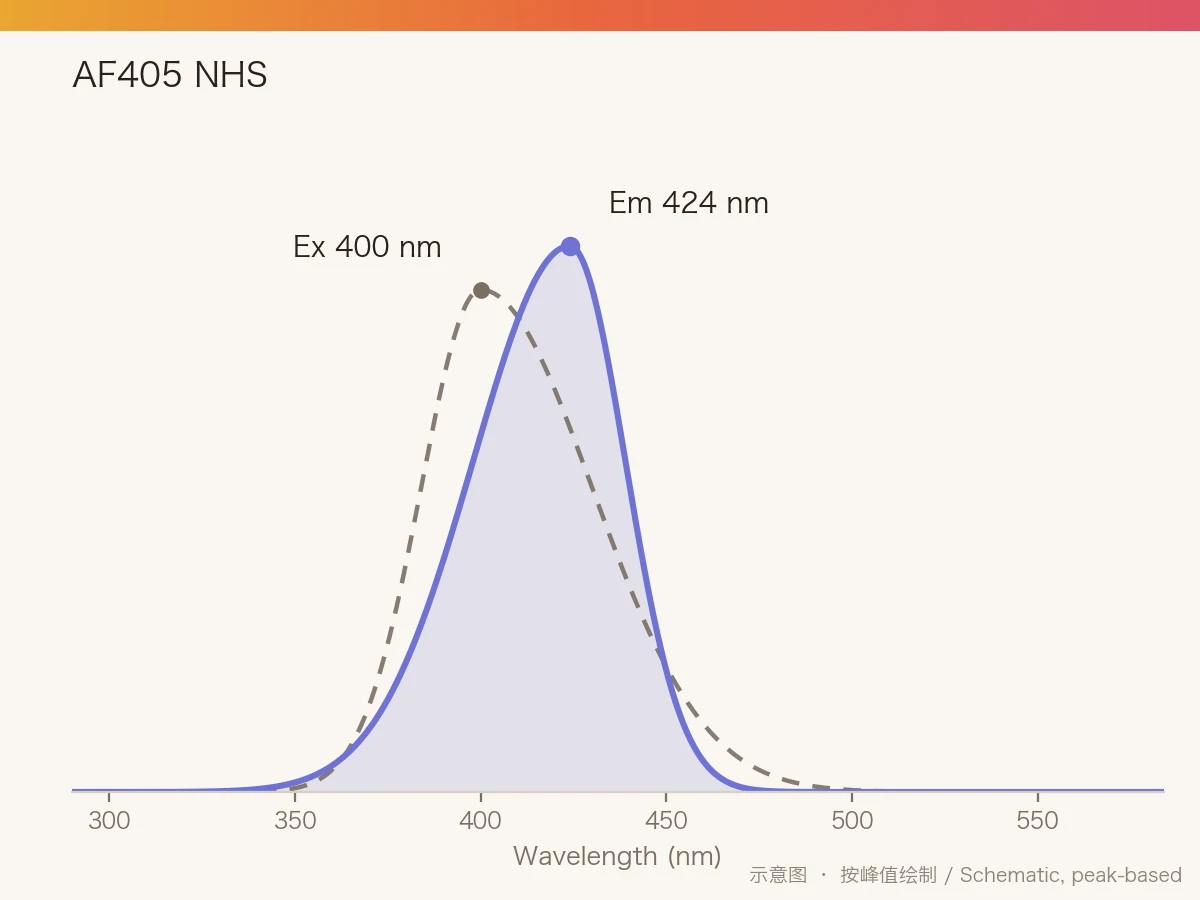
AF405 fluorescent dyes have NHS reference peaks of 400/424 nm, with five reactive derivatives and four bioconjugates for different labeling targets and chemistries.
Optical values are based on AF405 NHS.
Find AF405 dyes and conjugates by reactive group or recognition ligand.
Consider NHS for primary amines and Maleimide for free thiols. For click chemistry, confirm the reaction partners first.
Compare Annexin V, WGA, CTB, Streptavidin; check the sample and conditions.
| Product / catalog no. | Reactive form / ligand | Targets and applications | Documents |
|---|---|---|---|
| AF405 NHS EsterQH-10-1002 | NHS | Antibodies, proteins and other molecules with accessible primary amines | View product → |
| AF405 MaleimideQH-10-1002(Maleimide) | Maleimide | Targets with accessible free thiols | View product → |
| AF405 AzideQH-10-1002(Azide) | Azide | Targets with a compatible alkyne; confirm the click reaction system | View product → |
| AF405-PEG4-DBCOQH-10-1002(DBCO PEG4) | PEG4-DBCO | Azide coupling with a PEG4 spacer | View product → |
| AF405-PEG12-DBCOQH-10-1002(DBCO PEG12) | PEG12-DBCO | Azide coupling; evaluate a PEG12 spacer | View product → |
| AF405-Annexin VQH-10-1002(Annexin V) | Annexin V | Recognizes exposed PS; binding requires Ca²⁺ | View product → |
| AF405 WGAQH-10-1002(WGA) | WGA | Recognizes glycans containing GlcNAc or sialic acid | View product → |
| AF405 CTBQH-10-1002(CTB) | CTB | Recognizes GM1; consider binding and uptake conditions | View product → |
| AF405-StreptavidinQH-15-1002 | Streptavidin | Detect existing biotin labels using Streptavidin | View product → |
Showing 9 / 9 AF405 products
AF405 NHS has an excitation maximum of 400 nm. Check the instrument light source, excitation spectrum and emission collection window together.
Record the filter center and bandwidth, or the actual collection range. The 424 nm emission peak locates the signal; signal collection also depends on measured spectra and the optical path.
List other fluorescent labels, sample background and controls. Evaluate signal, background and channel interactions using the actual conjugate.
Record the model, source, filters and sample conditions, then check each against the product data.
Check accessible amines or thiols, sample purity and storage buffer before choosing NHS or Maleimide. Define any site-specific requirements before labeling.
Compare the two labeling routes →Identify the reactive groups on both partners, then compare Azide, DBCO and PEG spacers. Consider the reaction system and target compatibility together.
Search by recognition ligand, then confirm the target, sample preparation, working concentration and controls. No separate dye-conjugation step is needed.
| Stage | Questions to resolve | Further reading |
|---|---|---|
| Choose the labeling form | Which reactive groups are available? Will you label the target yourself or use a ready-made conjugate? | Find products by application → |
| Check sample conditions | Are the complete buffer composition, additives, available amount and purification requirements known? | NHS sample preparation → |
| Perform and assess conjugation | How will you record reagent input, remove free dye and assess molecular function? | NHS labeling workflow → |
| Configure detection | How will the light source, collection windows, other dyes and controls work together? | Check spectra and detection → |
Both products use DBCO chemistry with different PEG spacer lengths. Consider target accessibility, linkage and downstream detection. Chain length alone does not determine performance.
To compare the two forms, keep sample, reaction and detection settings consistent. Record product recovery, background and functional performance before assessing differences.
References on reaction chemistry, assay design and result interpretation.
Nanda JS, Lorsch JR. · Methods in Enzymology · 536:87–94 · 2014
Uses FAM ester labeling of a protein to explain primary-amine chemistry and labeling-efficiency assessment. It informs NHS workflow design; input and reaction conditions depend on the actual dye and sample.
Vira S, Mekhedov E, Humphrey G, Blank PS. · Analytical Biochemistry · 402(2):146–150 · 2010
Uses FITC-labeled anti-HA antibody to assess changes in labeling density and antigen binding. It informs input-series design and post-purification functional testing; DOL alone is insufficient for selecting a conjugate.
Cossarizza A, Chang HD, Radbruch A, et al. · European Journal of Immunology · 51(12):2708–3145 · 2021
Provides methodological guidance on detection settings, controls and experimental records for downstream conjugate evaluation.
NHS labels primary amines; maleimide labels free thiols. Additives and reduction requirements determine sample preparation.
AF405 NHS has 400 nm excitation and 424 nm emission peaks. A 405 nm source lies nearby. Check collection near 424 nm and excitation blocking; channel names do not replace actual wavelengths and bandwidths.
With AF350, DAPI or other blue labels, measure each single stain in every relevant channel. Use an unstained sample for baseline fluorescence, then apply the instrument’s compensation or unmixing procedure. Change the panel if signals remain poorly resolved.
When switching to AF488 or AF647, review the source, filter and working concentration. Compare specific signal and background at matched target input and record each detection configuration. Raw intensities from different channels do not directly rank dye brightness.
Tris and glycine consume NHS dye. BSA and gelatin require separation from the target protein; routine buffer exchange is insufficient.
The input ratio is the molar ratio added before reaction; DOL is the average number of bound dyes measured after purification.
Use DOL, recovery and control signals to distinguish insufficient labeling, purification carryover and loss of function.
Provide the catalog number when requesting documents, and the vial lot number for a CoA.
QH-10-1002(CTB)
QH-10-1002(WGA)
QH-10-1002(Annexin V)
QH-10-1002(DBCO PEG12)
QH-10-1002(DBCO PEG4)
QH-10-1002(Maleimide)
QH-10-1002(Azide)
QH-10-1002
QH-15-1002
| Resource type | Information to prepare | Resources |
|---|---|---|
| NHS product instructions or SDS | Catalog number QH-10-1002, document type and required language | Request NHS documents → |
| Batch CoA for purchased NHS product | Catalog number and vial lot number; ensure the document matches the current batch | Quality and batch information → |
| NHS reagent input and preparation parameters | Sample identity, concentration, volume and full buffer composition | Specifications → |
| Method preparation before reaction | Available groups, sample-processing limitations and planned purification | Pre-labeling checks and workflow → |
| Spectral or instrument-matching support | Specific product, light source, filters, sample and multicolor panel | Spectra and channels → |
| Other AF405 derivatives or conjugates | Product name and ligand / reactive group | Find the relevant product → |
Product name / catalog number, pack sizes and quantities, application and required delivery date.
Labeling target, available amount, complete storage buffer, purification method and instrument configuration.
Vial lot number, existing documents and versions, and the specific items to check.
Gather target-group and detection information before confirming the product and available documentation.
AF405 identifies the dye family. NHS, Maleimide, Azide, DBCO or a biological ligand identifies the product form. Each form has its own applications and documentation; packs are listed on the individual product page.
If you already have an antibody, protein or other molecule to label, check its available groups first. If you need a particular recognition ligand ready to use, compare its conjugates and confirm sample conditions and detection use.
Reactive groups, spacers and biological ligands change product identity. Obtain molecular-weight, preparation and storage information by catalog number. A batch CoA must also match the actual lot number.
AF405 NHS has excitation and emission maxima of 400/424 nm. Check the emission collection window and sample background, then validate with your samples and controls.
The figure marks the excitation and emission peaks of AF405 NHS Ester. Peak positions do not show bandwidth. Confirm measured spectra for each derivative or conjugate.
Spacer length is one selection variable. Consider the coupling partners, accessibility and product performance in actual experiments; PEG length alone does not determine the outcome.
The general amine-coupling approach can carry over, but reagent calculations, conditions, optical parameters and detection configuration need separate confirmation. Re-evaluate the resulting conjugate.
We use cookies and third-party analytics (Microsoft Clarity, Baidu Tongji, Google Analytics) to measure traffic and improve our service. Clarity includes session recording. You may decline — core site functionality is unaffected. View privacy policy