
Which groups are on your target?
Consider NHS for primary amines and Maleimide for free thiols. For click chemistry, confirm the reaction partners first.
Yellow emission, with 5 reactive dyes and 4 bioconjugates. Excitation near 561 nm and collection near 572 nm; find labeling methods and documents for the target handle.
Optical values refer to AF555 NHS.
Find AF555 dyes and conjugates by reactive group or recognition ligand.
Consider NHS for primary amines and Maleimide for free thiols. For click chemistry, confirm the reaction partners first.
Compare Annexin V, WGA, CTB, Streptavidin; check the sample and conditions.
| Product / catalog no. | Reactive form / ligand | Targets and applications | Documents |
|---|---|---|---|
| AF555 NHS EsterQH-10-1008 | NHS | Antibodies, proteins and other molecules with accessible primary amines | View product → |
| AF555 MaleimideQH-10-1008(Maleimide) | Maleimide | Targets with accessible free thiols | View product → |
| AF555 AzideQH-10-1008(Azide) | Azide | Targets with a compatible alkyne; confirm the click reaction system | View product → |
| AF555-PEG4-DBCOQH-10-1008(DBCO PEG4) | PEG4-DBCO | Azide coupling with a PEG4 spacer | View product → |
| AF555-PEG12-DBCOQH-10-1008(DBCO PEG12) | PEG12-DBCO | Azide coupling; evaluate a PEG12 spacer | View product → |
| AF555-Annexin VQH-10-1008(Annexin V) | Annexin V | Recognizes exposed PS; binding requires Ca²⁺ | View product → |
| AF555 WGAQH-10-1008(WGA) | WGA | Recognizes glycans containing GlcNAc or sialic acid | View product → |
| AF555 CTBQH-10-1008(CTB) | CTB | Recognizes GM1; consider binding and uptake conditions | View product → |
| AF555-StreptavidinQH-15-1007 | Streptavidin | Detect existing biotin labels using Streptavidin | View product → |
Showing 9 / 9 AF555 products
Values refer to this product’s specifications. Consult measurement records for solvent, pH and conjugation state.
Full product specifications →A 561 nm source is a candidate for evaluation; assess 543 nm excitation against actual spectra as well. Cy3 or TRITC presets do not define a universal optical path. Inspect the source, filters and detector configuration.
A 575/30 bandpass nominally spans 560–590 nm and includes the 572 nm emission peak. Collected signal depends on the full emission spectrum, filter transmission and detector response; this is a passband example. This example does not specify 561 nm laser blocking; use a filter set matched to the source and dichroic.
Read the detection guide →AF555 emission is very close to AF546 and may overlap Cy3-type collection windows. If a nearby-wavelength label is already present, first assess separation. Reaction activity, molecular weight and labeling calculations remain product-specific even for nearby spectral regions.
Multicolor detection considerations →For established recognition ligands, review the corresponding conjugates and their product-specific formulation, dose and storage conditions.
| Product | Recognition target and conditions |
|---|---|
| AF555-Annexin V | Phosphatidylserine; binding is Ca²⁺ dependent. |
| AF555 WGA | GlcNAc- or sialic-acid-containing glycans; consider sample preparation and intracellular signal. |
| AF555 CTB | GM1 ganglioside; confirm the application and treatment conditions. |
| AF555-Streptavidin | Biotinylated targets; account for competing free biotin. |
References on reaction chemistry, assay design and result interpretation.
Nanda JS, Lorsch JR. · Methods in Enzymology · 536:87–94 · 2014
Uses FAM ester labeling of a protein to explain primary-amine chemistry and labeling-efficiency assessment. It informs NHS workflow design; input and reaction conditions depend on the actual dye and sample.
Vira S, Mekhedov E, Humphrey G, Blank PS. · Analytical Biochemistry · 402(2):146–150 · 2010
Uses FITC-labeled anti-HA antibody to assess changes in labeling density and antigen binding. It informs input-series design and post-purification functional testing; DOL alone is insufficient for selecting a conjugate.
Cossarizza A, Chang HD, Radbruch A, et al. · European Journal of Immunology · 51(12):2708–3145 · 2021
Provides methodological guidance on detection settings, controls and experimental records for downstream conjugate evaluation.
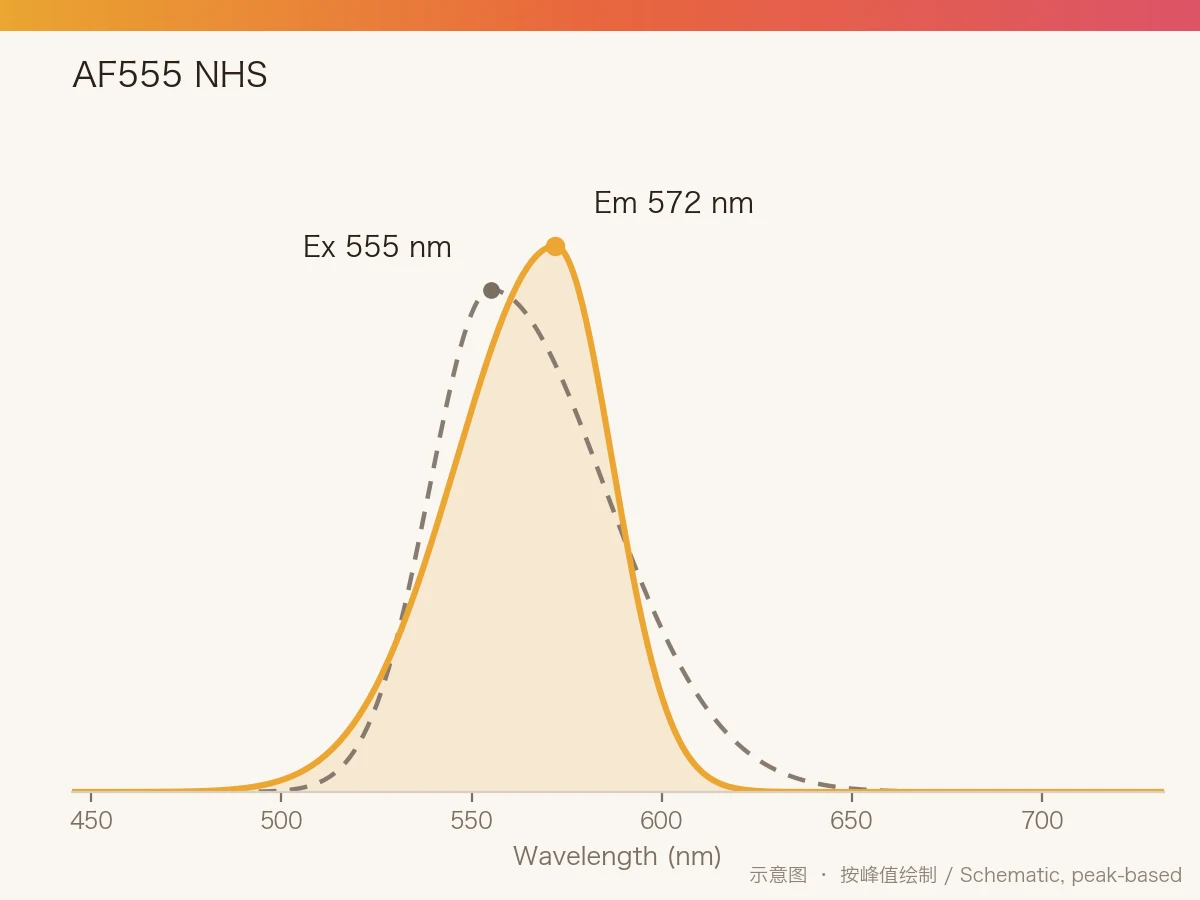
AF555 NHS has an excitation peak of 555 nm and an emission peak of 572 nm. Check the product name, source wavelength and collection window separately. A 561 nm source is a candidate for evaluation; assess 543 nm excitation against actual spectra as well. Cy3 or TRITC presets do not define a universal optical path. Inspect the source, filters and detector configuration.
A 575/30 bandpass nominally spans 560–590 nm and includes the 572 nm emission peak. Collected signal depends on the full emission spectrum, filter transmission and detector response; this is a passband example. This example does not specify 561 nm laser blocking; use a filter set matched to the source and dichroic.
The peak-position figure cannot compare brightness or calculate compensation. Use measured spectra to inspect filter coverage, then unstained and single-stain samples to assess background and signal. Keep gain or exposure fixed when comparing samples.
chroma.com
tools.thermofisher.com
AF555 emission is very close to AF546 and may overlap Cy3-type collection windows. If a nearby-wavelength label is already present, first assess separation. Reaction activity, molecular weight and labeling calculations remain product-specific even for nearby spectral regions.
Measure each single-stain sample in every relevant channel and use an unstained sample for baseline fluorescence. Set conventional-flow compensation from these measurements or use dye- and treatment-matched references for spectral unmixing. If signals remain poorly resolved, change the dye panel or detection windows.
When comparing dye conjugates of the same target, match target concentration and labeling density and record each source and filter. A brighter reading in one channel may reflect better excitation or collection. Compare specific signal, background, recovery and function alongside raw intensity.
Cossarizza A, Chang HD, Radbruch A, et al. · European Journal of Immunology · 51(12):2708–3145 · 2021
chroma.com
NHS labels primary amines; maleimide labels free thiols. Additives and reduction requirements determine sample preparation.
Terminal alkynes pair with azides through CuAAC; DBCO pairs with azides through copper-free SPAAC.
Compare labeling density, sample recovery, specific signal and background after purification, rather than total fluorescence alone.
Instructions, SDS, product specifications and CoA are catalog-specific. Request documents on the corresponding product page and include the vial lot number for a CoA.
QH-10-1008
QH-10-1008(Maleimide)
QH-10-1008(Azide)
QH-10-1008(DBCO PEG4)
QH-10-1008(DBCO PEG12)
QH-10-1008(Annexin V)
QH-10-1008(WGA)
QH-10-1008(CTB)
QH-15-1007
Include the target, reactive handles, buffer formulation, excitation source and emission window to help identify the product and supporting measurement information.
AF555 NHS has an excitation peak of 555 nm and an emission peak of 572 nm. Check the product name, source wavelength and collection window separately.
Nearby detection windows do not establish identical chemistry. Dosing requires the molecular weight of the AF555 reactive form; labeling calculations also need its extinction coefficient and absorption corrections. Request missing parameters first.
AF555 emission is very close to AF546 and may overlap Cy3-type collection windows. If a nearby-wavelength label is already present, first assess separation. Reaction activity, molecular weight and labeling calculations remain product-specific even for nearby spectral regions.
Use NHS for primary amines, Maleimide for free thiols, Azide for terminal or strained alkynes, and PEG4-DBCO or PEG12-DBCO for azides. Each product page covers pretreatment, buffer and purification requirements.
Follow each product page and vial label. Reactive dyes in this catalog are stored dry at −20°C and protected from light; aqueous conjugates have separate requirements. Prepared dye solutions and newly made conjugates cannot simply inherit dry-dye storage conditions.
Do not borrow these values. Reactive form, spacer, structure and salt form can affect them; confirm by catalog number. Request missing identity and calculation parameters through the product Documents tab rather than inferring them from a similar name.
Use Documents on the specific product page and describe the application and detection settings. Supply the catalog and vial lot numbers for a CoA. The displayed spectrum is a peak schematic and references concern methods; neither is a lot inspection result.
We use cookies and third-party analytics (Microsoft Clarity, Baidu Tongji, Google Analytics) to measure traffic and improve our service. Clarity includes session recording. You may decline — core site functionality is unaffected. View privacy policy