
DBCO
Accessible target-bound azide groups
DBCO is a strained alkyne that cycloadds to an azide. Ordinary unmodified proteins lack this paired handle; residual free azide reagents can consume DBCO.
SF647: DBCO, NH2. Select the form for the sample handle and readout.
2 products
2 matching products
| Product / Cat. No. | Chemistry | Excitation / nm | Emission / nm | Pack sizes | Product details |
|---|---|---|---|---|---|
| SF647-NH2QH-12-1011(NH2) | NH2 | 651 | 672 | 1 mg / 5 mg / 10 mg / 25 mg / 100 mg | |
| SF647-DBCOQH-12-1011(DBCO) | DBCO | 651 | 672 | 1 mg / 5 mg / 10 mg / 25 mg / 100 mg |
Need help with reactive forms or detection channels?
QH-12-1011(NH2)
| Product / Cat. No. | Form | Ex / Em · nm |
|---|---|---|
| SF647-DBCOQH-12-1011(DBCO) | DBCO | 651 / 672 |
| SF647-NH2QH-12-1011(NH2) | NH2 | 651 / 672 |
SF647 is offered with a free amine on the dye (NH2) or a DBCO group for azide-bearing samples. Select for the existing handle, acceptable reaction sequence and purification conditions.
Accessible target-bound azide groups
DBCO is a strained alkyne that cycloadds to an azide. Ordinary unmodified proteins lack this paired handle; residual free azide reagents can consume DBCO.
Activated carboxyls, or free thiols through a linker such as SMCC
NH2 is a primary amine on the dye, not an NHS ester. Two unactivated primary amines do not couple directly. Use carboxyl activation, or react the dye amine with the NHS end of SMCC before coupling its maleimide end to a target thiol.
Compare purified products made from the same sample preparation, recording input, recovery, negative background and function. Match target amount and acquisition settings before assessing intensity, photobleaching or another endpoint.
Selection criteria
Compare each product’s excitation and emission with the instrument’s light source, filters and detector. A number in a product name does not replace its specifications.
An NH2 dye needs an activated carboxyl partner or bridging route; DBCO needs accessible azides on the target. Confirm target modification, then compare steps and removal of free components.
Compare specific signal, negative background and function at matched sample input and acquisition settings. Titrate the purified conjugate.
Sample and experimental preparation
For an SMCC route, couple the dye amine and remove free linker before target-thiol coupling. Choose separation for the intermediate size; a protein desalting column does not necessarily retain a small dye intermediate.
Confirm target azide installation and remove free azide reagent. Check sodium azide and other competing small molecules in the buffer. Use a no-azide target control to assess adsorption background.
Retain an unlabeled aliquot from the same preparation. Measure concentration, labeling density and function after purification. Use the actual conjugate for single-color references in multicolor detection.

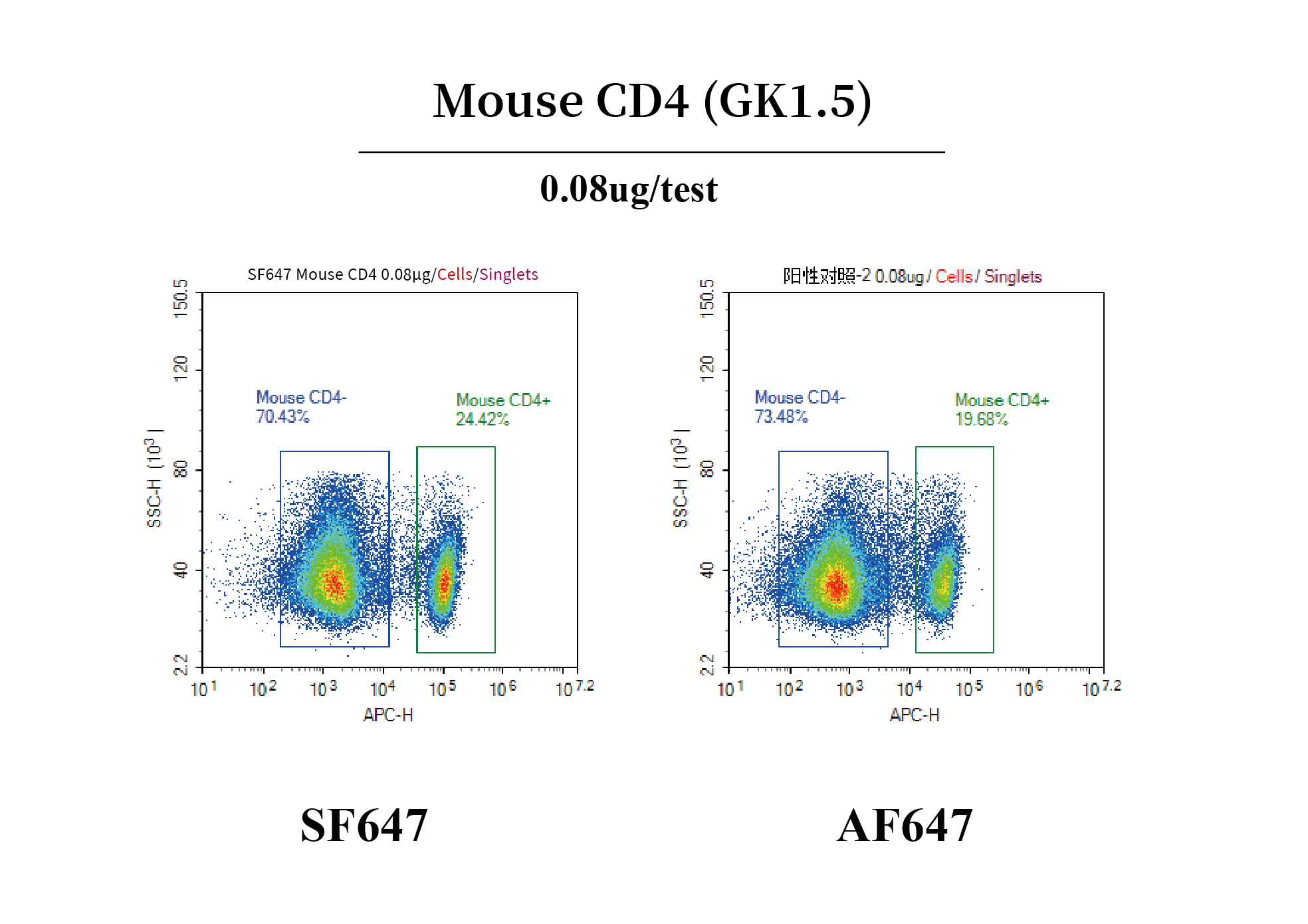
SF647 and Qihe AF647, Mouse CD4 (GK1.5), 0.08 µg/test. CD4+ gated events: 24.42% and 19.68%. Gated percentages alone do not measure intrinsic dye brightness.
Target-bound azides enable coupling; free azide reagents and sodium azide can compete for DBCO.
Use product analysis to separate low conversion from detection bias, and a no-azide control to check adsorption.
Terminal alkynes pair with azides through CuAAC; DBCO pairs with azides through copper-free SPAAC.
Couple the dye amine, isolate the intermediate and react it with target thiols; check free SMCC, competing reductants and small-molecule separation.
Cysteines may be disulfide-bound or protected. Confirm free thiols before deciding on reduction.
Compare labeling density, sample recovery, specific signal and background after purification, rather than total fluorescence alone.
Thermo Fisher Scientific · SMCC and Sulfo-SMCC · MAN0011295 Rev. C.0
Distinguishes the partners and reaction order of the NHS and maleimide ends and removal of free linker, supporting bridging routes for NH2 dyes.
Debets MF, van Berkel SS, Schoffelen S, et al. · Chemical Communications · 46(1):97–99 · 2010
Reports copper-free reaction of a strained alkyne with azides and its application to enzyme PEGylation.
DOI: 10.1039/b917797c
Agard NJ, Prescher JA, Bertozzi CR. · Journal of the American Chemical Society · 126(46):15046–15047 · 2004
Introduces ring-strain-driven azide–alkyne coupling without copper, a foundational study in SPAAC bioconjugation.
DOI: 10.1021/ja044996f
thermofisher.com
Reactive handles, buffer compatibility and method guidance.
thermofisher.com
Reactive handles, buffer compatibility and method guidance.
Shafer DE, Inman JK, Lees A. · Analytical Biochemistry · 282(1):161–164 · 2000
Examines TCEP interactions with reactive groups, informing evaluation of reductant carryover and buffer exchange.
Request the manual, SDS or lot-specific CoA by catalog number. Include the vial lot number for a CoA.
Product use, preparation, operating conditions and storage.
Lot-specific test methods and results.
Handling, storage and emergency response information.
Identify the sample handle or required recognition mechanism, then select a matching reactive dye or preconjugated probe. Use preparation, reaction and storage requirements for the exact catalog number.
NH2 is the free amine on the dye. Coupling it to ordinary amines such as antibody lysines requires a defined activation or bridging route.
Match target concentration, acquisition settings and sample processing. Compare labeling density together with specific signal, negative background, recovery and function; a free-dye or single endpoint measurement does not assess every performance characteristic.
Use molecular weight, an appropriate extinction coefficient and protein-absorbance correction for the exact catalog number after removing free dye. Request parameters not shown on the product page through its Documents tab.
We use cookies and third-party analytics (Microsoft Clarity, Baidu Tongji, Google Analytics) to measure traffic and improve our service. Clarity includes session recording. You may decline — core site functionality is unaffected. View privacy policy