
Short answer: Qihe's QuickTag Antibody Labeling Kit first uses an enzymatic reaction to introduce azide groups at the Fc glycan region of a suitable IgG, then connects the desired probe through copper-free click chemistry. AF488-DBCO, AF594-DBCO and AF647-DBCO are available options. Confirm the antibody species, subclass, Fc status and formulation before ordering.
Finding a suitable antibody clone does not always mean that the fluorescent conjugate you need is available. This can complicate a custom flow cytometry panel or a cell imaging experiment. Choosing another pre-conjugated product may require changing clones; preparing your own conjugate requires attention to the attachment site, formulation and antibody performance after labeling.
The QuickTag Antibody Labeling Kit offers a route that starts with an existing IgG. It establishes a reactive handle at the Fc glycan region, then connects a probe selected for the intended assay, without genetic modification of the antibody.
What distinguishes Fc glycan modification with QuickTag?
Conventional NHS ester labeling reacts with available primary amines on the protein. QuickTag uses enzymatic modification at the IgG Fc glycan region, followed by copper-free click conjugation between the introduced azide groups and DBCO or sDIBO probes.
The Fc region is away from the Fab antigen-binding region, making this route an option for studies in which the location of modification matters. The labeled antibody should still be evaluated for binding or staining in its intended assay. Species, subclass and Fc status can also affect modification. For background on common reaction routes, see NHS ester versus maleimide antibody labeling.
Which samples should you evaluate first?
Consider QuickTag when you already have a suitable IgG clone and want a fluorescent conjugate compatible with your instrument, or when you need a reactive handle for subsequent functional probe attachment. Azide-modified antibodies can also be coupled to appropriately functionalized probes such as biotin or oligonucleotides.
The kit is optimized for IgG Fc glycan labeling and is suitable for many IgGs. Suitability does not extend to every IgG. Antibodies with engineered Fc regions or altered Fc structure or glycosylation should be assessed before purchase. The kit is not recommended for proteins other than IgG.
Review the formulation as well. The product manual states that BSA itself does not inhibit labeling by this route. High concentrations of exogenous glycoproteins may compete for reaction substrate. Providing the complete storage-buffer composition helps determine whether a sample is suitable for the workflow.
What are the stages from IgG to a fluorescent antibody?
First, perform enzymatic modification and purification. Introduce azide groups at the Fc glycan region, then remove excess substrate to obtain an antibody ready for click conjugation.
Next, attach the selected probe. Use an azide-compatible DBCO or sDIBO probe for copper-free click chemistry. For fluorescence detection, select the dye according to the instrument channels and assay design.
Finally, purify and evaluate the conjugate. Remove excess free dye and assess staining performance and background. For absorbance-based labeling measurements, see how to calculate DOL and interpret the result. Other proteins in the sample can affect the absorbance measurements.
In the manual's example using 500 μg of antibody and AF594-DBCO, enzymatic modification takes 1–2 hours and the click reaction takes 1–2 hours or overnight. These are individual reaction times; the complete preparation also includes sample preparation and purification. Confirm the applicable conditions against the product instructions and sample requirements.
How do you choose between AF488, AF594 and AF647?
QuickTag offers AF488-DBCO, AF594-DBCO and AF647-DBCO options. Start with the instrument's lasers, filters and available detection channels, then consider the dyes already in the panel, target expression and assay background.
When requesting a quote, specify both the desired dye and antibody amount to be processed. Current product options are listed below; confirm the exact configuration when ordering.
| Product information | Current options |
|---|---|
| Product name | QuickTag Antibody Labeling Kit |
| Catalog number | QH-K00001 |
| Sizes | 100 / 250 / 500 μg |
| Fluorescent dye options | AF488-DBCO / AF594-DBCO / AF647-DBCO |
What does the OKT3 and AF594 flow cytometry example show?
The manual presents flow cytometry results for a CD3E (OKT3) antibody modified with QuickTag and labeled with AF594. CD3-positive and CD3-negative populations can be distinguished under the sample and detection conditions used in that experiment.
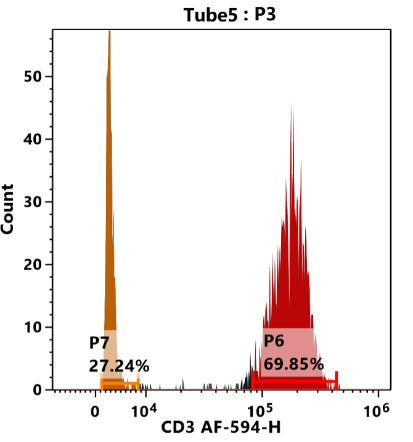
Figure 1. OKT3 and AF594 flow cytometry histogram. Within Tube5: P3, the CD3-positive peak P6 is 69.85% and the negative peak P7 is 27.24%. The original validation image from the product manual is retained.
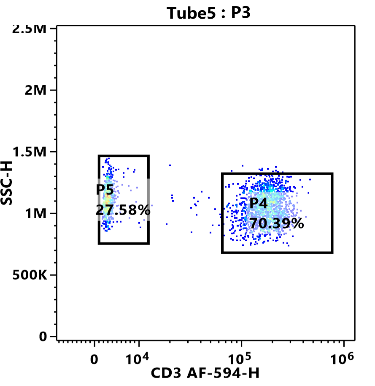
Figure 2. Flow cytometry scatter plot from the same example. Within Tube5: P3, CD3-positive population P4 is 70.39% and negative population P5 is 27.58%. The original validation image from the product manual is retained.
These percentages describe cell populations within the relevant gates. The example supports population separation by this OKT3 and AF594 conjugate under those conditions. It does not establish labeling efficiency, recovery or a percentage of retained affinity, and it does not replace independent validation of other antibodies or AF488 and AF647 combinations.
What information should you send Qihe before selecting a kit?
Prepare the antibody identity or clone, species and subclass, concentration and available amount, complete storage-buffer composition, desired dye, instrument channels and intended assay. Include any Fc engineering or glycan treatment.
Visit the QuickTag product page or send these details to the Qihe technical team to assess sample suitability and confirm the kit size and dye option.
Frequently asked questions
Does the antibody require genetic modification?
No. QuickTag introduces azide groups enzymatically, followed by click conjugation.
Can a conventional NHS ester dye be used directly in the second stage?
The second stage uses a probe compatible with the azide handle, such as a DBCO or sDIBO probe. A conventional NHS ester has a different reactive group. Check both the dye identity and reactive chemistry when ordering.
Can an antibody formulated with BSA be considered?
Yes, subject to sample assessment. The manual states that BSA itself does not inhibit labeling by this route. Review other formulation components and exogenous glycoproteins as well, and select downstream purification and quantification methods accordingly.
Does the AF594 example validate other colors or antibodies?
Each combination requires assessment. The two figures show the OKT3 and AF594 example. Other antibody and probe combinations should be checked for signal, background and functional performance in their intended assays.
For research use only. Not for use in diagnostic procedures.