
A common challenge in antibody internalization experiments is distinguishing antibodies bound to the cell surface from those taken up into the cell. With conventional fluorescent labeling, both populations may contribute to the signal and complicate interpretation.
Qihe's pHrodo series uses fluorescence enhancement following environmental acidification to help observe changes after labeled molecules enter acidic intracellular compartments. The series includes pHAb, pH560 Red, pH630 Deep Red and a rapid labeling reagent for human antibodies. Selection depends on detection channels, antibody conditions and the labeling strategy.
How pHrodo dyes support antibody internalization studies
These dyes fluoresce weakly in a neutral environment. After a labeled antibody is taken up into the progressively acidifying endosomal and lysosomal system, the local pH falls and fluorescence increases. This change provides an acidification-associated readout across time points or treatment conditions.
The response helps reduce background contributions from labeled molecules in a neutral extracellular environment. It supports studies of antibody internalization, receptor-mediated uptake, and related endocytosis and phagocytosis processes. In antibody screening, interpret this readout alongside target binding, cell condition and other relevant results.
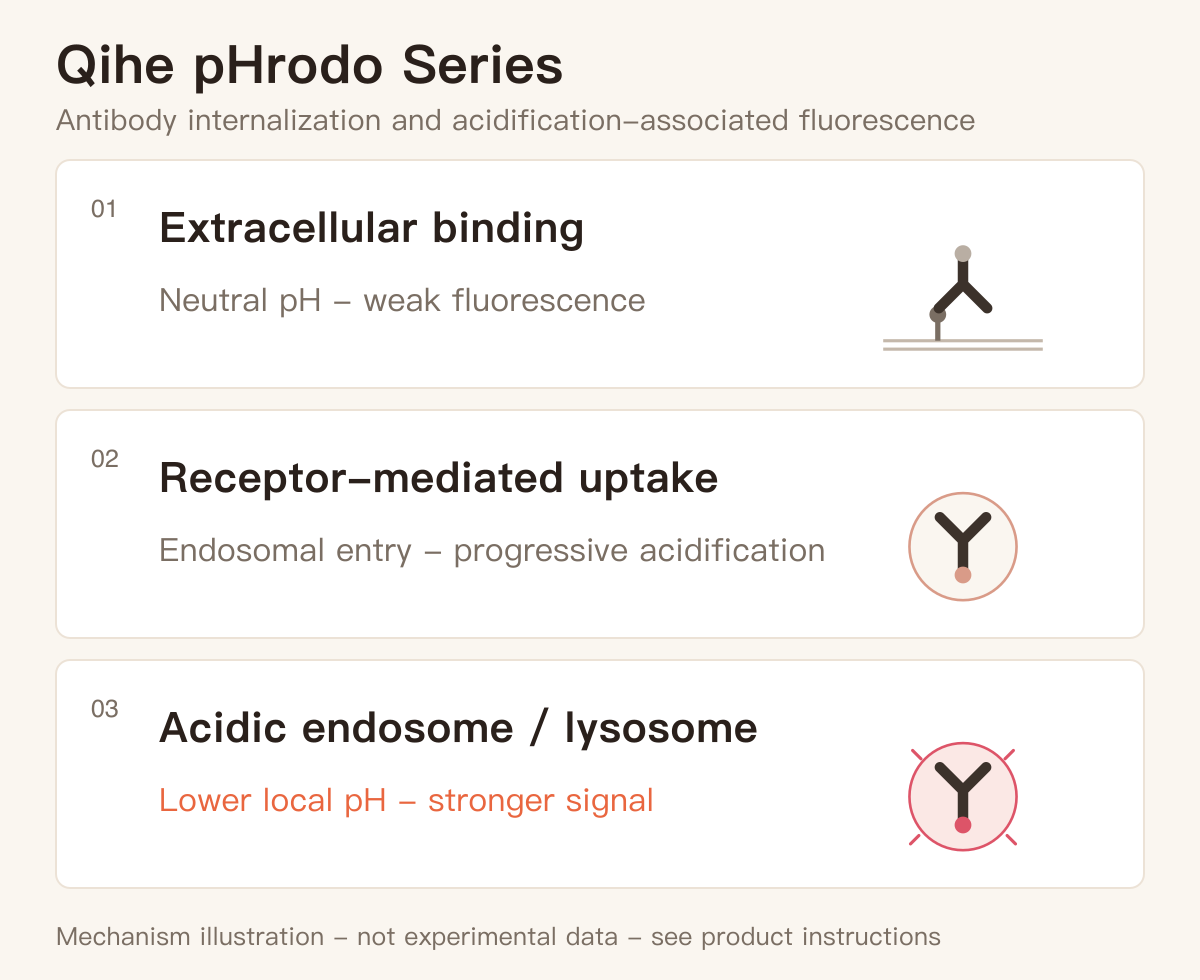
Figure 1. Illustration of antibody internalization and acidification-associated fluorescence changes; not experimental data. Response ranges and assay conditions depend on the specific product's instructions.
Choosing between pHAb, pH560 Red and pH630 Deep Red
First confirm the instrument's detection window, then select the reactive derivative and sample preparation workflow.
| Product | Spectral information | Available reactive derivatives | Selection considerations |
|---|---|---|---|
| pHAb | Absorption/emission maxima: 532/560 nm | NHS ester, Maleimide | Antibody internalization studies; choose a solution or magnetic bead workflow according to sample conditions |
| pH560 Red | Excitation/emission maxima: 560/585 nm | TFP ester, Maleimide | Place acidification-associated signals from labeled antibodies or proteins in a red detection window |
| pH630 Deep Red | Excitation/emission maxima: 640/655 nm | TFP ester, Maleimide | Observe signals associated with acidic compartments, such as late endosomes and lysosomes, in a deep red detection window |
pHAb: account for antibody sample conditions. Solution and magnetic bead workflows are supported. The bead-based route can connect antibody purification and labeling, providing an option to assess for low-concentration or unpurified antibodies. Pack sizes are 250 µg and 1 mg.
pH560 Red: an option for a red detection window. The TFP ester labels primary amines, while Maleimide labels free thiols. Choose the conjugation route according to available groups on the antibody or protein. Both derivatives are available in 100 µg and 1 mg sizes.
pH630 Deep Red: focus on deep red signals in acidic compartments. Its approximate pKa is 5, and detection can be planned with a standard Cy5 filter set. When a green label is already in use and an acidification-associated readout is desired in a deep red channel, this is a candidate to evaluate. See the pH630 Deep Red Maleimide product page.
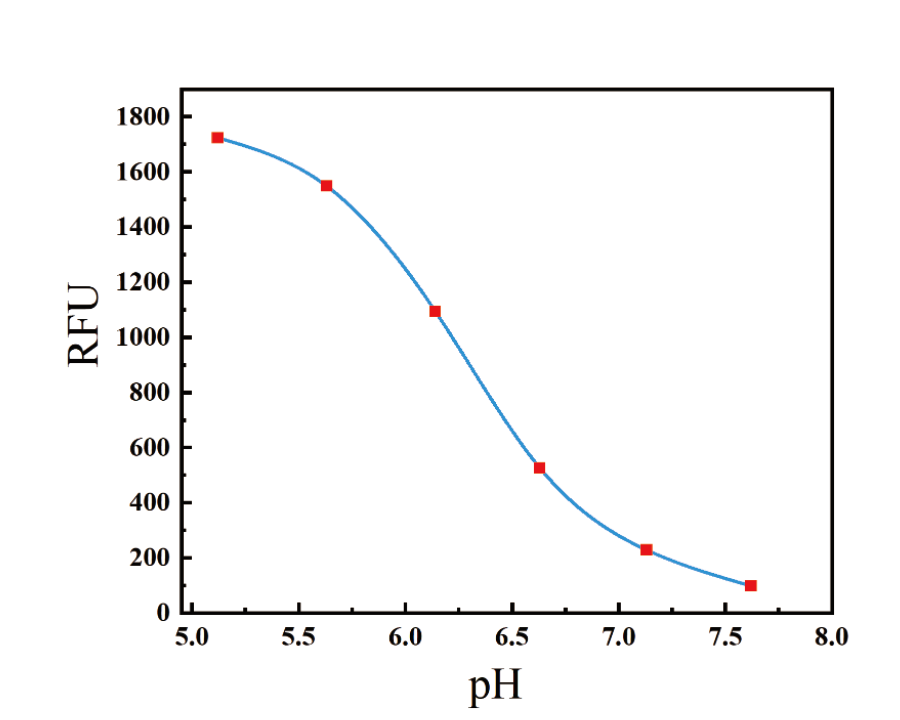
Figure 2. pH response curve from the pH630 product materials. Relative fluorescence units (RFU) increase as the environment becomes more acidic. Complete test conditions were not provided with the source figure; it illustrates the response trend and does not support comparisons between products.
The wavelengths in the table are peak values, not instrument laser wavelengths. The spectral regions of pHAb and pH560 Red are close to one another. For multicolor experiments, assess spillover using the actual lasers, filters and other dyes.
A rapid labeling option for human antibody internalization studies
For human antibody internalization studies where fewer preparatory steps are desired, Qihe offers pH630 Deep Red anti-human labeling reagent, catalog number QH-17-1003.
The reagent can be mixed with the human antibody in culture medium without exchanging the antibody's original buffer. After the labeling incubation specified in the corresponding instructions, add the mixture to the cell assay. The excitation/emission maxima are 640/655 nm, the concentration is 0.5 mg/mL, and the pack size is 200 µL.
This companion reagent follows a different workflow from separately supplied reactive dyes. Confirm suitability for the intended antibody before use.
Choose a labeling route based on available functional groups
For covalent labeling, available primary amines correspond to pHAb NHS ester or pH560/pH630 TFP esters; available free thiols correspond to Maleimide. If disulfide reduction is required, follow the specific antibody and reagent workflow and verify antibody binding after labeling.
Use a suitable reaction buffer for amine-reactive dyes and consider interference from free amines such as Tris and glycine. For the thiol route, establish the available thiols and residual reducing agents. Follow the specific product's instructions for reagent input, reaction pH, time and subsequent purification.
Interpreting increased fluorescence
The fluorescence of pHrodo dyes primarily reflects acidification of the labeled molecules' local environment. Labeling level, cell condition and other factors also affect the readout. When comparing antibodies or treatment conditions, include unlabeled, negative and time-point controls and assess consistency in the degree of labeling.
Weak fluorescence alone cannot establish that internalization has not occurred during early uptake stages that have not yet acidified sufficiently. If total internalization or a specific trafficking step is the primary question, combine this readout with other methods suited to that question.
Start with the sample and detection channels
When planning studies of antibody internalization, protein uptake or phagocytosis, first summarize the molecule to be labeled, antibody origin, concentration and buffer formulation, instrument channels and the time range of interest.
Use Qihe's technical consultation page to request product instructions, specifications and selection guidance. For a labeling service assessment, include sample information so that a suitable approach can be discussed.
All products in this series are for research use only.