
Short answer: Sulfonation generally improves the water solubility of cyanine dyes and supports aqueous use. However, a product named Cy3 is not necessarily non-sulfonated. Check the actual structure, reactive group and dissolution instructions together.
Orange-red labeling reagents may be sold as Cy3, Cyanine3 or Sulfo-Cy3. Although they occupy a similar color range, their dissolution requirements and sample compatibility can differ.
For protein labeling, establish whether the specific structure is sulfonated, which reactive group connects it to the protein, and whether the sample tolerates the required solvent system.
Establish which structure the product name represents
Cy3 is not a complete structural description. Some catalogs distinguish non-sulfonated Cyanine3 from Sulfo-Cyanine3, while other water-soluble, sulfonated products are simply named Cy3. Do not classify every Cy3 product as non-sulfonated.
Compare the structure, CAS identifier, reactive form and solubility documentation. The distinction discussed here concerns sulfonated and non-sulfonated structures within a cyanine family. The product name alone does not rank performance.
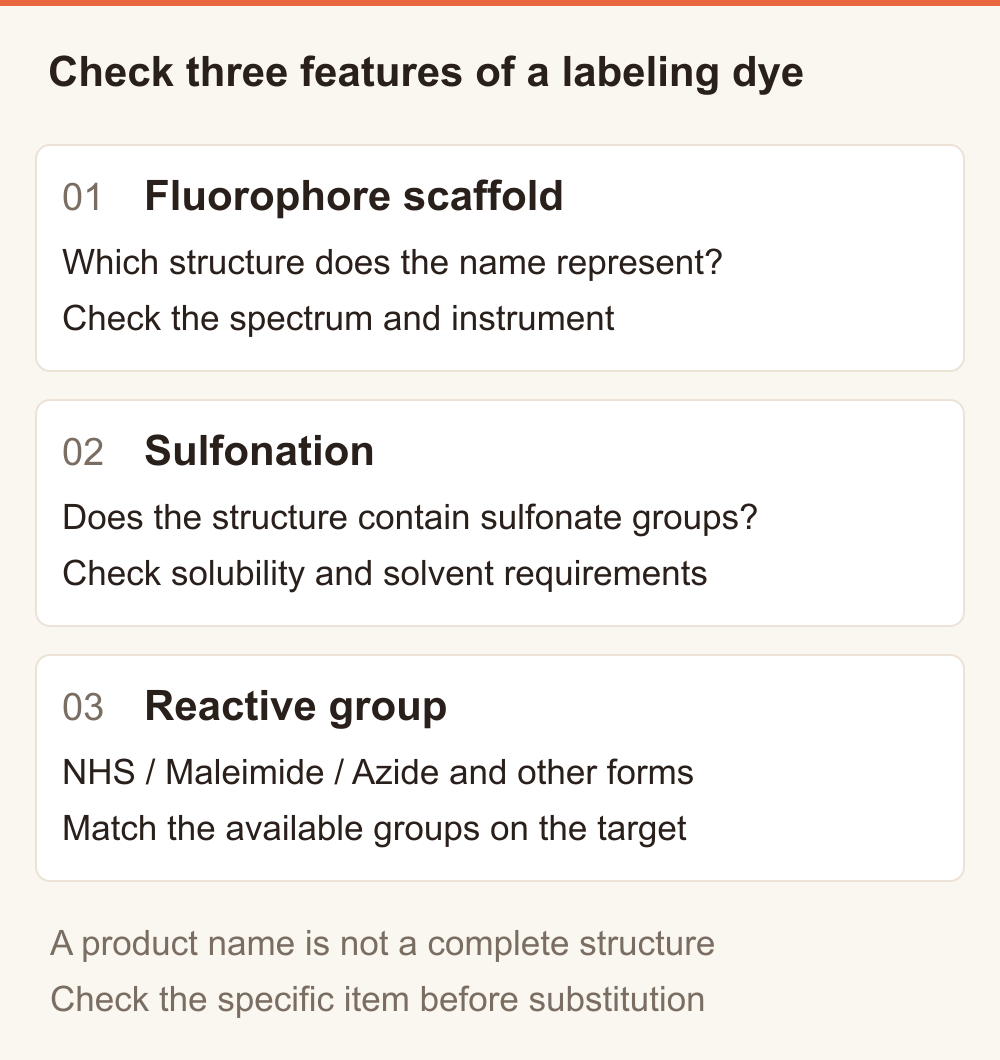
Figure 1. Check the fluorophore scaffold, sulfonation and reactive group separately to avoid choosing a suitable color with an unsuitable attachment chemistry.
What does sulfonation primarily change?
Sulfonate groups increase the hydrophilicity of cyanine dyes and can reduce certain aggregation problems in water. Water solubility is generally better than that of the corresponding non-sulfonated form.
For a protein sample, this affects solvent selection. An aqueous-compatible dye is worth assessing when the protein is sensitive to organic co-solvents. Non-sulfonated forms generally require dissolution in an appropriate organic solvent before addition to a compatible reaction mixture. Follow the instructions for the specific product; conditions for one structure or supplier do not automatically apply to another.
Does better water solubility mean greater brightness?
The Sulfo prefix alone does not rank brightness. Corresponding sulfonated and non-sulfonated cyanines can have similar spectra, but spectral similarity, water solubility and experimental signal are separate considerations.
After conjugation, also evaluate labeling degree, protein condition, free-dye removal and assay background. Define the samples, detection conditions and assessment criteria when comparing options. Properties of the dye in solution do not establish the staining performance of its conjugate.
Do Cy3 NHS and Sulfo-Cy3 NHS label the same functional groups?
If both products contain an NHS ester, both can react with available primary amines, including lysine side chains and the protein N-terminus. Sulfonation influences properties such as hydrophilicity, while the NHS ester provides the attachment chemistry.
Include the full product name and reactive form when requesting a quote. Cy3 NHS, Cy3 Maleimide and Cy3 Azide are not interchangeable simply because their names contain Cy3. For common attachment routes, see NHS ester versus maleimide labeling.
| Feature to check | Question it answers |
|---|---|
| Actual structure and sulfonation | How does the dye dissolve, and does it suit the sample? |
| NHS ester, maleimide or another reactive form | Can it attach to the available groups on the target? |
| Spectrum and instrument channels | Are the excitation and detection settings suitable? |
| Stock, reaction and purification requirements | Can the complete workflow be performed? |
A water-soluble dye still needs appropriate handling
Dissolving in water does not establish suitability for long-term aqueous storage. An NHS ester can still hydrolyze, so its reactivity and storage requirements need separate attention.
Qihe's Cy series NHS dye instructions call for protection from moisture and preparation and prompt use of dye stocks as directed. When changing structure or product specification, check the applicable instructions again before retaining the previous stock-storage method. Purify the labeled sample appropriately before subsequent measurements or assays.
What should you tell Qihe before ordering?
Provide the target molecule and available reactive groups, sample concentration and total amount, complete buffer composition, tolerance to organic solvents, intended instrument channels and purification method. If you have a reference product, include its full name or structural information.
For example, current documentation lists Qihe Cy3 NHS as QH-30-3001, with Ex/Em of 554/566 nm. Confirm the structure, dissolution and reaction requirements for the specific catalog item. Share different solubility or reactive-form requirements with the Qihe technical team to confirm a suitable product and pack size.
Frequently asked questions
Does the name Cy3 establish that a product is water-insoluble?
No. Naming conventions vary. Check the actual structure and solubility instructions.
Can Sulfo-Cy3 directly replace the Cy3 I previously used?
Identify the original structure and reactive group, then review solvent requirements, input calculations and purification. Even with similar detection channels, validate the new conjugate in the intended assay.
Does a water-soluble dye still require free-dye removal?
The sample still needs appropriate purification. Water solubility does not establish that free dye has been removed or replace assessment of the purification result.
For research use only.